Behind the Move · Issue #005 · Week 35, 2026 · Theme — The Jobs Revision Doesn't Move the Dollar. The Regime Does.
The Jobs Revision Doesn't Move the Dollar. The Regime Does.
Why the same employment revision can produce very different reactions in FX.
−911,000 jobs.
That was the preliminary US jobs benchmark revision released in September 2025. The Bureau of Labor Statistics estimated that the level of total nonfarm employment in March 2025 was 911,000 lower than the original estimate — a downward revision of 0.6%.
It was an enormous number. And the obvious conclusion is: "That must be terrible for the Dollar."
But here's the problem. The Dollar does not have a fixed reaction to a jobs revision.
The same type of revision can produce very different market behaviour depending on what investors already believe about the economy, Federal Reserve policy, interest rates and the Dollar itself.
That is especially relevant now, because the next preliminary benchmark revision is scheduled for August 28, 2026. So before we look at the next number, let's look at what happened before.
1. Four Revisions. Four Different Environments.
Here are the last four major preliminary national benchmark revisions:
- 2022 · +462,000 — tight labour market, aggressive Fed tightening.
- 2023 · −306,000 — Fed still in a rate-hike regime.
- 2024 · −818,000 — USD already under pressure, dovish expectations building.
- 2025 · −911,000 — labour-market concerns, Fed-cut expectations.
The BLS figures are not estimates of monthly job creation. They are adjustments to the March employment level, based on more comprehensive employment data from the Quarterly Census of Employment and Wages.
That distinction matters. A benchmark revision tells us: "Our previous estimate of the size of the labour market was wrong by this much." It does not automatically tell us: "The Dollar should move this way."
2. Why the Same Revision Can Produce Different Reactions
Markets don't trade economic information in isolation. They trade it against expectations.
Imagine the market is already firmly positioned around a hawkish Federal Reserve. Rates are expected to stay high, the Dollar is strong, the labour market appears resilient. Then a downward employment revision arrives. That information challenges the existing story. The Dollar might initially weaken — but if the broader market still believes the Fed needs to remain restrictive, the reaction can fade.
Now change the environment. Suppose investors are already moving toward lower US rates. The Dollar is weakening, Treasury yields are falling, and the market is increasingly concerned about labour-market deterioration. A large downward revision arrives. This time, the number is telling the market something it is already prepared to believe. The revision reinforces the existing story.
3. 2022: When the Revision Agreed With the Regime
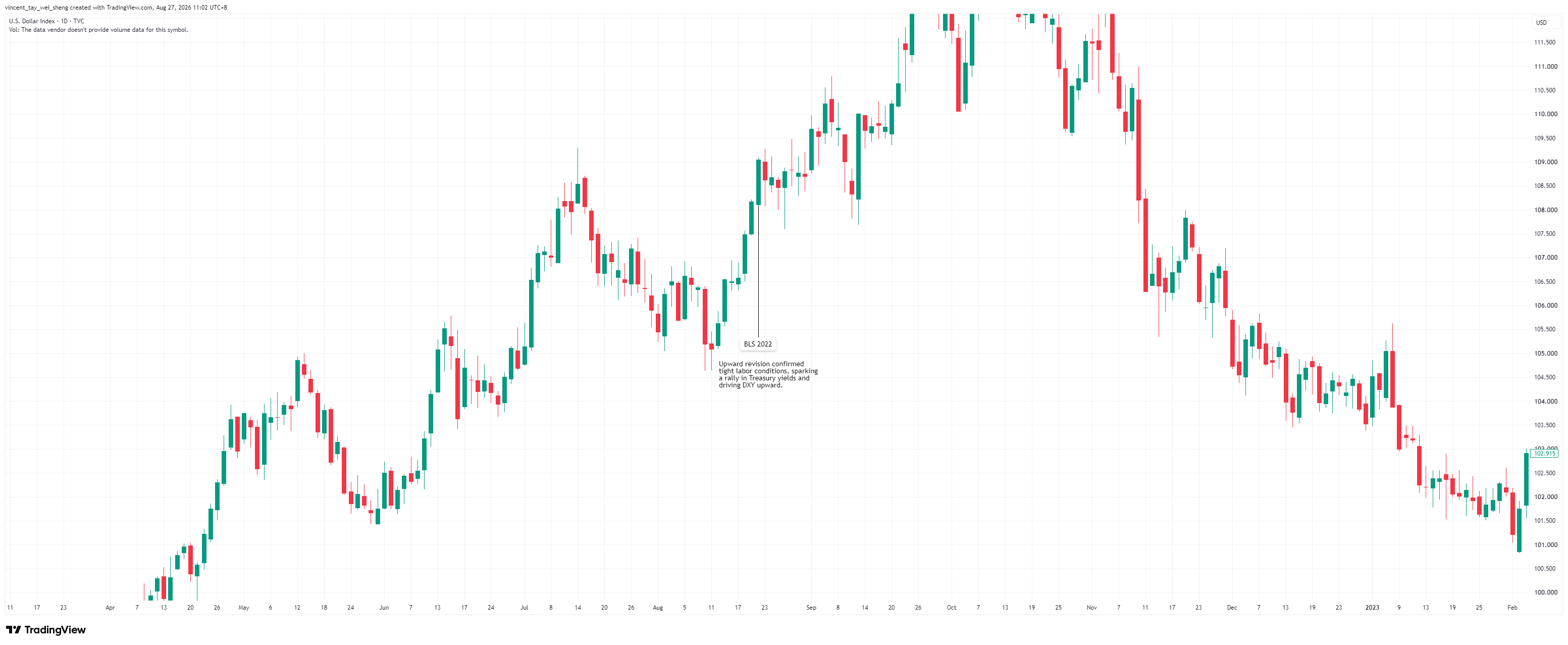
In August 2022, the preliminary benchmark revision increased the estimated March 2022 employment level by 462,000, or 0.3%.
The broader environment was aggressively hawkish. The Federal Reserve was tightening, the labour market remained strong, and investors were focused on persistent inflation and further rate increases. A positive employment revision therefore fitted comfortably into the existing narrative.
The important point isn't "+462k made USD rise." The better interpretation is that the revision provided information consistent with an already-hawkish macro regime — and the Dollar's broader behaviour reflected that environment.
4. 2023: A Negative Revision That Fought the Regime
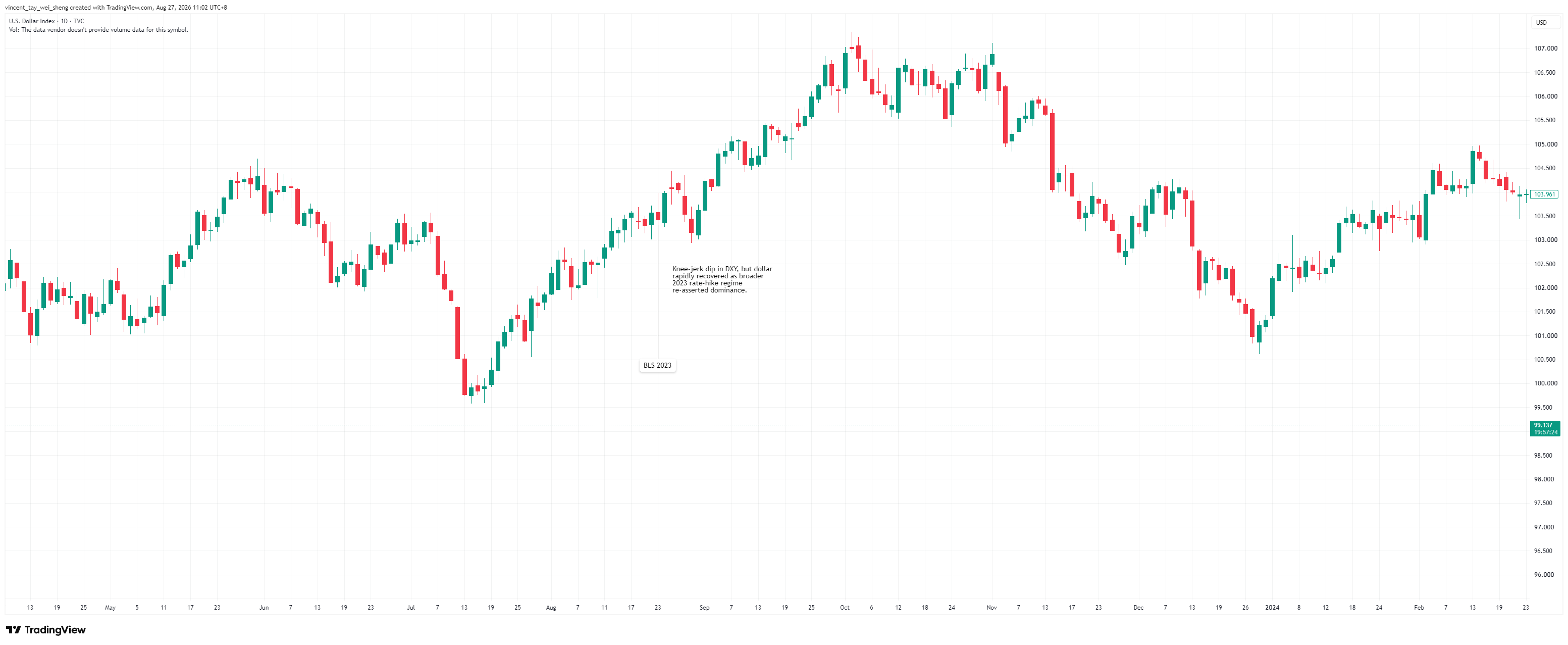
One year later, the preliminary benchmark revision was −306,000. At first glance, that looks Dollar-negative.
But the Federal Reserve was still operating inside a tightening cycle. The market had not yet fully abandoned the idea that US rates needed to remain restrictive. So the revision challenged the prevailing narrative rather than confirming it. The initial Dollar reaction was relatively short-lived.
And that is precisely why this example is useful: a negative number does not automatically overpower the bigger market regime.
5. 2024: The Big Revision Arrives During Dollar Weakness
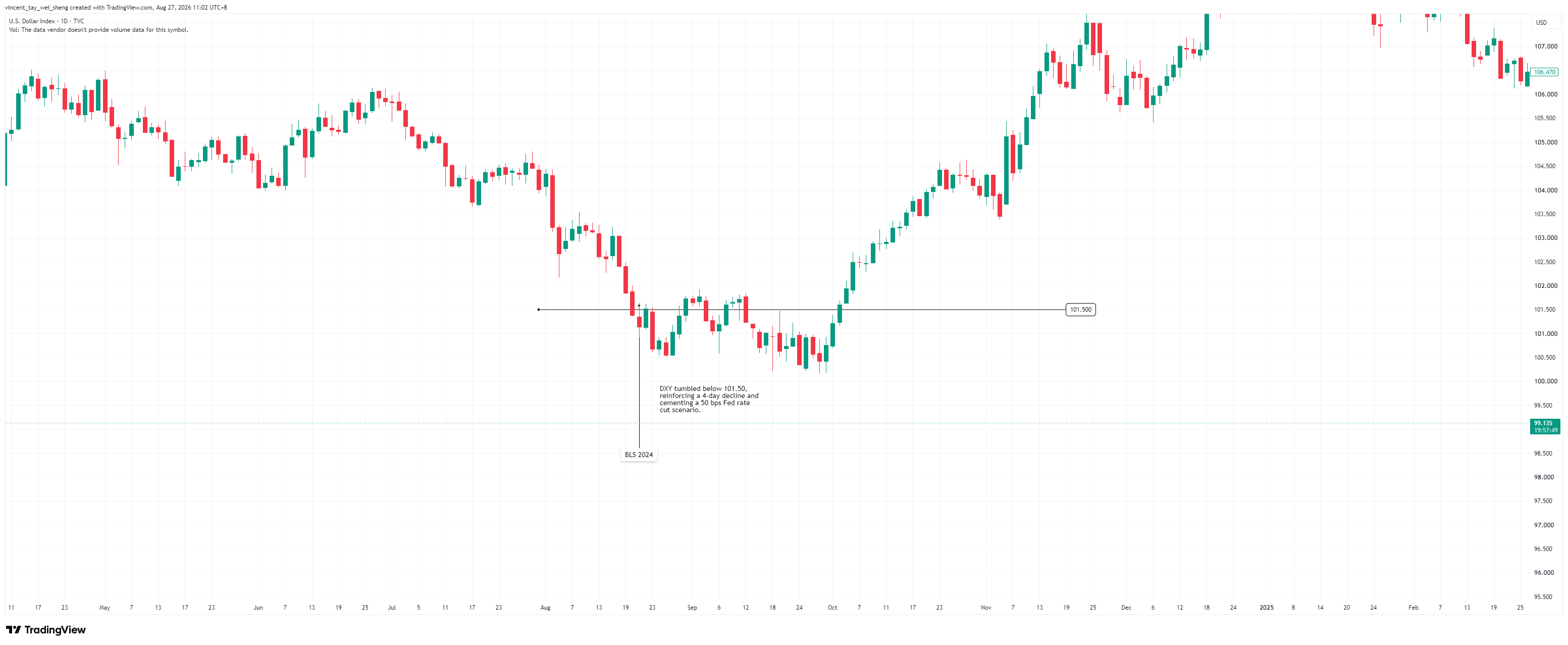
In August 2024, BLS announced a preliminary benchmark revision of −818,000, equivalent to −0.5% of March employment. This was a much larger revision.
But again, the important question is not simply how large the number was — look at the environment. The Dollar was already under pressure and markets were increasingly focused on the possibility of easier Federal Reserve policy heading into Jackson Hole. Contemporary reporting described DXY around 101.50 after a period of Dollar weakness. The immediate reaction was not a simple one-way collapse either; the Dollar briefly stabilised and snapped part of its losing streak.
That makes the example more interesting, not less. The revision was consistent with concerns about the labour market, but the market response itself was mixed. So we should not rewrite history and say "−818k caused the Dollar to fall." The evidence does not support that level of certainty.
6. 2025: The −911,000 Revision
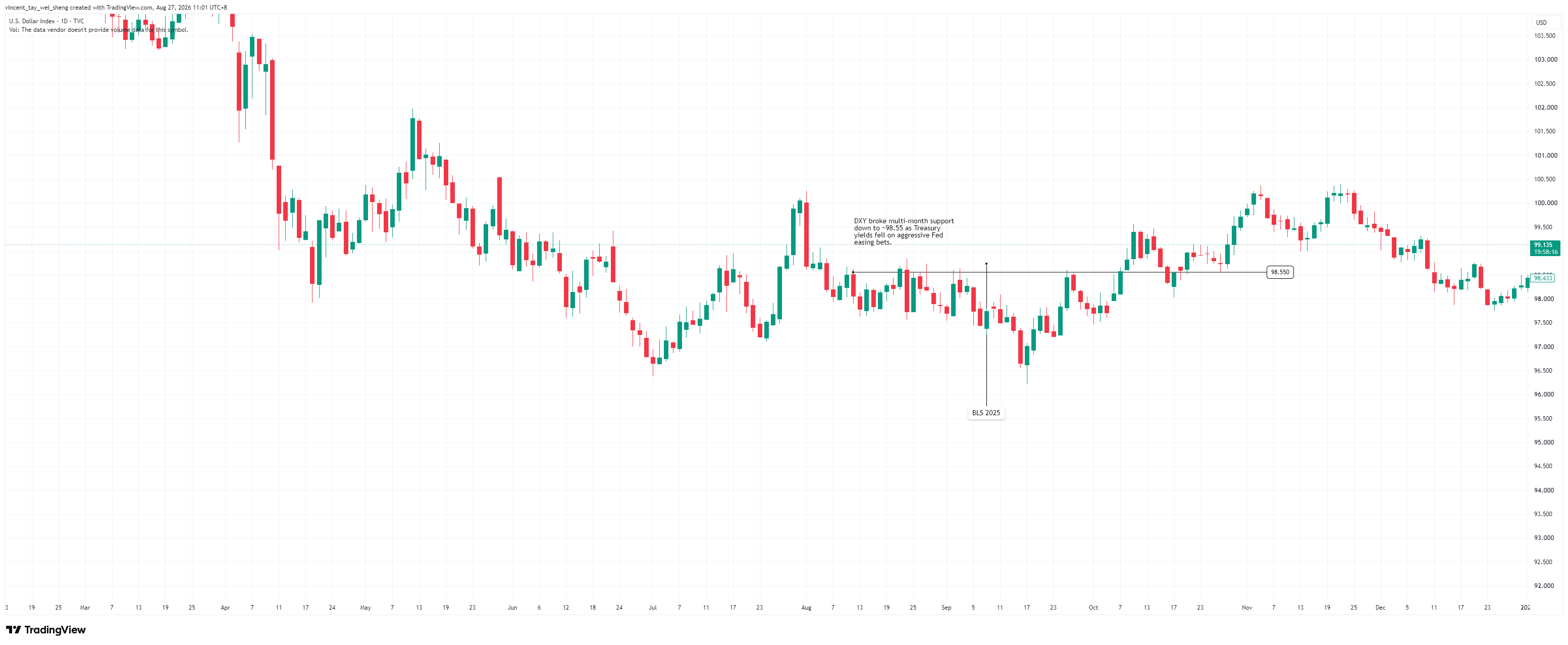
Then came the largest revision in this four-year sample: −911,000. BLS estimated that March 2025 total nonfarm employment had been overstated by 911,000 jobs. That sounds like an obvious Dollar-negative shock.
And the initial market reaction was indeed Dollar-negative in parts of the FX market. But it was not a clean, one-way Dollar collapse. Reuters reported that the Dollar initially fell against the yen after the release, but later trimmed those losses. Another Reuters market report noted that the Dollar Index actually rose on the day.
This is perhaps the most useful example of all: the largest revision did not produce a simple mechanical Dollar reaction. Why? Because the market was already focused on the possibility of Fed rate cuts. The revision reinforced concerns about the labour market, but traders were simultaneously looking at upcoming inflation data and the broader rate outlook. The number mattered — but the number did not determine the entire market reaction.
7. The Pattern Is About Regime, Not Direction
Now we can see why the headline relationship is dangerous. It would be easy to conclude: negative jobs revision = weaker Dollar. But the historical evidence doesn't give us that rule.
A better framework is:
A revision that confirms the existing regime can add fuel to an existing move. A revision that contradicts the regime may create an initial reaction that struggles to persist. And sometimes even a revision that agrees with the regime produces a messy or muted response, because other factors dominate.
8. The Most Important Distinction: Confirmation vs. Creation
This is the heart of the lesson. We should be careful with language such as "the −911k revision caused USD to fall." That implies causality we cannot establish from this small sample.
Instead: the −911k revision arrived in an environment where concerns about the US labour market and Fed easing were already important to markets. That's a much stronger statement — it separates what happened from our interpretation of why it mattered.
And this is where the FXStrength philosophy matters:
Price is evidence, not proof.
We can observe what price did. We can compare it with yields and rate expectations. We can ask whether the macro narrative and market behaviour agree. But we should not manufacture certainty simply because two things happened at the same time.
9. The 2026 Revision Is Coming
The next preliminary benchmark revision is scheduled for August 28, 2026 — 10:00 a.m. ET, when BLS publishes the preliminary revision for March 2026 employment.
This gives us another opportunity to test the framework. But the interesting question isn't "Will the revision be positive or negative?" The better questions are:
- What is the market already expecting?
- What is the Dollar already doing?
- Where are Treasury yields moving?
- Is the Federal Reserve becoming more or less likely to ease?
And finally: does the new information confirm the existing story — or challenge it?
10. How to Read the Number When It Arrives
When the revision hits, work through four questions:
- 1. What changed? How large is the revision, and is it meaningfully different from what the market expected?
- 2. Compared with what? A −500k revision sounds enormous — but its importance depends on what investors had already priced in.
- 3. What regime are we in? Is the market currently focused on persistent inflation, a strong labour market, slowing growth, Fed easing, or rising/falling Treasury yields? The same revision means different things in each.
- 4. Does price confirm the story? Does the Dollar actually move? Do Treasury yields respond? Does the move persist beyond the first reaction, or does the market quickly reverse?
That last step is crucial. A number is information. Persistence is evidence that the market cares.
The Important Caveat: We Only Have Four
Here we need to be especially honest. Four observations are nowhere near enough to establish a trading rule. There are two major limitations:
- Small sample. We are comparing only four annual preliminary benchmark revisions. That's tiny.
- Confounding factors. The revisions did not happen in isolation. They arrived alongside Fed policy changes, inflation releases, Treasury-yield moves, positioning shifts, geopolitical developments and other employment data. And the two largest negative revisions occurred in environments where the Dollar and rate expectations were already changing.
We therefore cannot cleanly separate revision → USD move from existing regime → USD move, with the revision arriving at the same time.
What to Remember
Don't trade the revision. Read the regime.
A −900,000 revision sounds like an obvious Dollar-negative event. But the number does not have a fixed market reaction. Its importance depends on:
- what investors already expected,
- what the Federal Reserve was expected to do,
- what Treasury yields were doing,
- what the Dollar was already doing,
- and whether price actually followed through.
A revision that agrees with the existing regime can reinforce a move. A revision that fights the regime may struggle to change the bigger picture. And sometimes the market simply has something else it cares about more.
Question of the Week
The Lesson
A big revision doesn't tell you where the Dollar is going. It tells you that our understanding of the economy has changed. The regime and the market reaction tell us how important that change actually is. This is the difference between reading a headline and reading a market.
The beginner sees:
A better framework asks:
What You Learned
A benchmark revision tells you our estimate of the economy has changed — not which way the Dollar goes. The number matters most when it agrees with the regime already in place.
What Price Is Saying
Price is evidence, not proof. The first reaction tells you the market noticed; whether the Dollar and yields keep moving together tells you whether it's actually repricing — or just reacting to a headline.
How FXStrength Helps
The benchmark revision speaks to the US labour market; the driver framework frames the broader Dollar story; and the strength meter adds another piece of evidence — is USD weakness broad-based across currencies, or concentrated in one or two pairs? None of it tells you what to trade. It helps separate the information from the market's response to it.
Sources
- U.S. Bureau of Labor Statistics — Preliminary CES Benchmark Revisions, 2022–2026.
- Reuters — September 2025 market reaction to the −911,000 revision.
- Reuters / FXStreet — August 2024 market reaction to the −818,000 revision.